
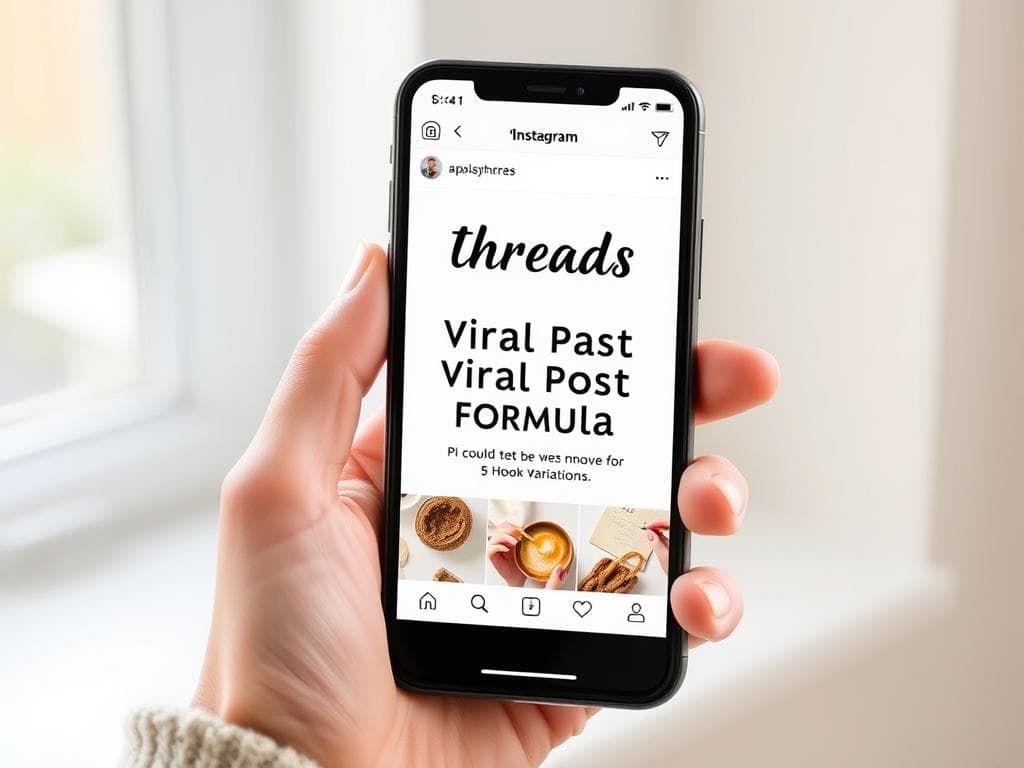
Threads Viral Post Formula (5 Hook Variations)
Breaks virality into a repeatable structure — hook, line-break rhythm, reply bait. Comments are the metric Threads rewards most, and this formula farms them on purpose.
prompt
Write 5 Threads posts for {business} about {topic}, aimed at {audience}. Use the viral formula: line 1 is a bold hook under 15 words that sparks curiosity or mild controversy; lines 2-4 deliver one concrete insight or story beat each, separated by line breaks for easy scanning; the final line asks a reply-bait question to drive comments. Keep each post under 280 characters, conversational and slightly imperfect like a real person typing — no hashtags, at most 2 emojis per post. Vary the 5 hooks: a hot take, a confession, a numbers claim, a before/after comparison, and a question. End post 5 with the CTA {cta}.
Variables
This prompt uses the variables below. Fill them in when you hit Copy — anything left blank keeps its {placeholder}.
- {business}Business or brand
- e.g. 夜市雞排攤「脆脆雞」
- {topic}Post topic
- e.g. 為什麼我們的雞排要醃 24 小時
- {audience}Target audience
- e.g. 20-35 歲愛逛夜市的上班族
- {cta}CTA
- e.g. 追蹤看明天炸什麼
Use case
Small business owners and social media managers whose Threads posts keep landing on zero engagement.
How to use it
Fill four variables and run it: {business} is your shop or brand, {topic} is the single subject for this batch (e.g. 'why we marinate our chicken for 24 hours'), {audience} is who is actually scrolling (the more specific the age and identity, the sharper the writing), and {cta} is the closing action for post 5. All three of chatgpt, claude and gemini handle this fine, though claude usually lands the most human, slightly-off cadence. Do not paste all five raw: pick the two or three that read most naturally, manually loosen any sentence that feels too tidy, drop in a filler word or a deliberately unfinished beat, and optionally turn a single post into an image card in Canva. The prompt already locks in 'no hashtags, max 2 emojis per post' — glance over the output to catch any the model sneaks back in.
Why it works
What makes this prompt work is that it reverse-engineers what the algorithm actually feeds on into copyable parts. Threads rewards comment density, so the prompt hard-codes the last line as a reply-bait question instead of letting the model close however it likes — a question forces the reader to type, and typing is what compounds reach. The 'under 15 words' hook, 'one idea per line', and 'under 280 characters' rules all fight the small phone screen: long openers get truncated before the fold and dense paragraphs go unread. Banning hashtags and capping emojis at two forces the post to read like a real person typing rather than a marketer's layout, killing the sponsored vibe. And forcing five different hook types (hot take, confession, numbers, before/after, question) hands you five test variants to see which one detonates, so you never lean on one move until followers tune out.
Tips & variations
- Feed {topic} one subject at a time — do not cram 'marinade + oil temp + sauce' into one run. The narrower the topic, the more distinct angles the five hooks can take without colliding.
- To find your strongest hook type, run the same {topic} twice: once on defaults, once with 'make all five open with a numbers claim' appended, then A/B them on comment count.
- Do not let {cta} be a bare 'follow us' — phrase it as 'follow to see what we fry tomorrow' so there is a reason to stay; a teaser converts far better than a naked follow button.
- 280 characters still has slack: after the batch, append 'cut each post to under 120 characters' to force the model to keep only the spiciest line — it reads faster on mobile and avoids the truncation fold entirely.
Recommended tools
Contains affiliate links: we may earn a commission when you purchase or sign up through them, at no extra cost to you.
Related prompts
髮型顧問
髮型分析+臉型分析+整體建議+每一款髮型簡短說明
 Social Posts
30-Day Social Content Calendar (4-Pillar Rotation)
The 40/30/20/10 pillar ratio keeps your feed helpful instead of salesy, and weekday batching compresses a month of content into one filming afternoon.
 Social Posts
Grand Opening Post Pack (FB + IG + LINE)
One brief, three platform-native posts — not copy-paste. Facebook drives tagging, Instagram drives reach, and the LINE broadcast drives walk-ins during opening week.
 Social Posts
Customer Testimonial Story Post (Before-After-Bridge)
Testimonials flop when they read like ads. This structure lets the customer do the selling — verbatim quotes plus measurable results beat any tagline you could write.
 Social Posts
Bakery New Flavor Launch Carousel (Sensory Close-Up Story)
One sense per slide turns swiping into a virtual tasting, and the scarcity slide converts cravings into next-morning queues at the counter.
 Social Posts
Bubble Tea Behind-the-Counter Reel Script (30s Shot List)
The 3-second satisfying-pour hook stops the scroll, and the timestamped shot list means you can film and edit the whole Reel in one lunch break.